
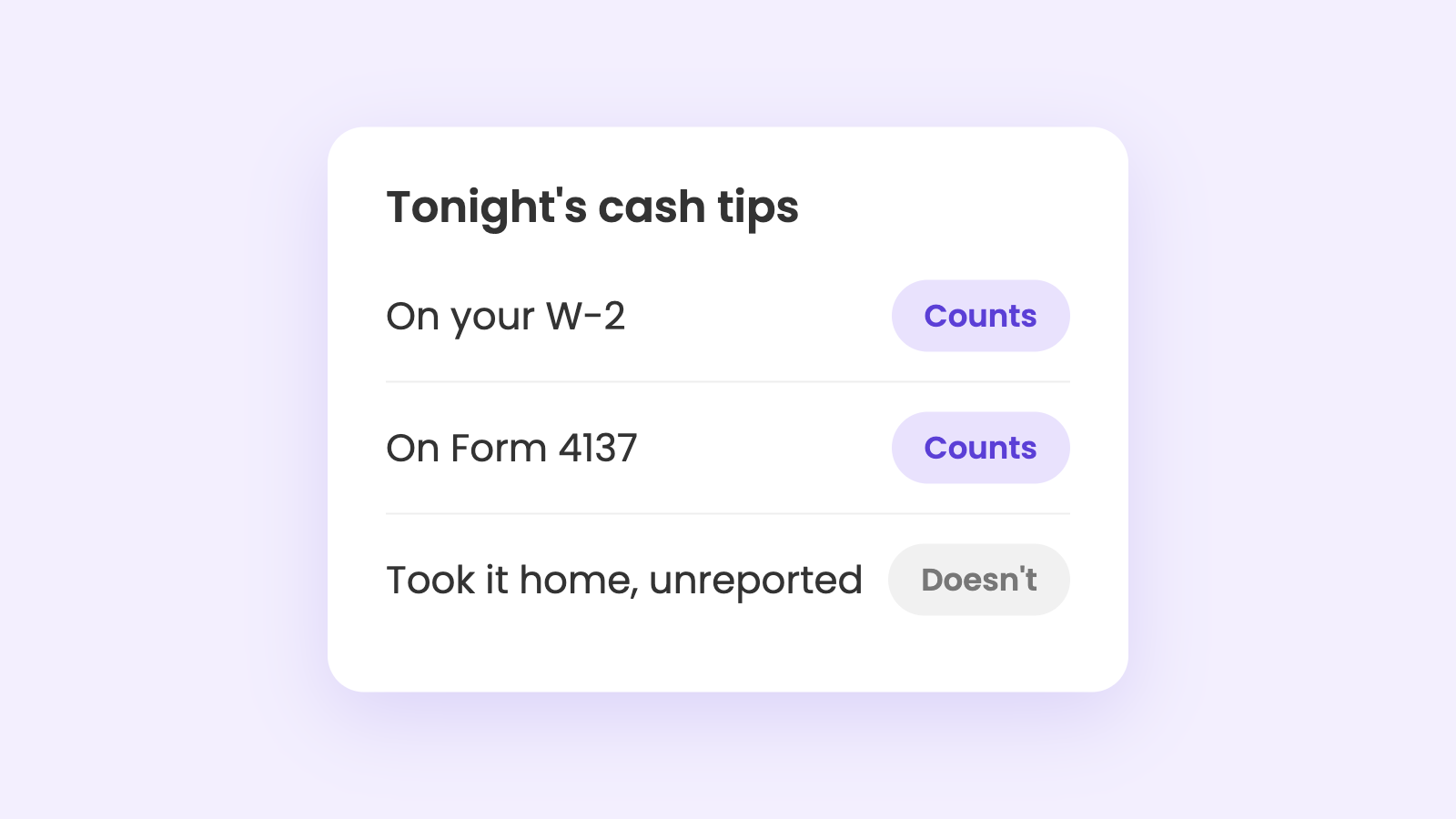
Only if they get reported. The new federal deduction lets tipped workers take up to $25,000 of tips off their federal taxable income for 2025 through 2028. But a tip only counts if it shows up on your W-2 or another tax form, or you report it yourself on Form 4137, the form for tips your employer never knew about. Cash that went home with you and never got reported doesn't qualify.
That's a bigger deal behind the bar than it sounds.
Do people really not report cash tips?
In my experience, a lot of cash tips still go unreported. If the owner doesn't make you turn them in so they end up on your paycheck, and you walk out with the cash at the end of the night, you usually just take it home. You could report it. You usually didn't.
For years that was the norm. A lot of our money came in cash, and what got reported was what came through on cards, or whatever the bar needed to hit 8%. Fewer bars look the other way now.
That 8% comes from a real rule, but it isn't a cap on what you owe. Bars and restaurants that normally have more than 10 employees on a typical day have to allocate tips when the tips their staff report add up to less than 8% of food and drink sales. That means the bar splits the shortfall among its tipped staff on paper, and it shows up in box 8 of their W-2s. The IRS is clear that all tips are income. You're supposed to report your tips to your employer in writing every month they hit $20 or more at that job, by the 10th of the next month (IRS Publication 531).
What is the no tax on tips deduction?
It's a federal income tax deduction created by the tax law signed on July 4, 2025, commonly known as the One Big Beautiful Bill Act. Here's how it works, according to the IRS:
- Up to $25,000 of qualified tips per tax return. That's per return, so a married couple still gets $25,000 total, and married couples have to file jointly to claim it.
- Tax years 2025 through 2028.
- You can take it whether you itemize or take the standard deduction.
- It shrinks once your modified adjusted gross income passes $150,000, or $300,000 filing jointly (final rules).
- You need a Social Security number that's valid for work.
- You claim it on the new Schedule 1-A.
A deduction shrinks the income you pay federal tax on. It's not a $25,000 check.
Do you still pay tax on your tips?
Yes. Uncle Sam still gets his cut. The deduction only covers federal income tax, and you still pay Social Security and Medicare on every tip you report, which is 7.65% for most employees (IRS Topic 751). State income tax depends on your state, so check yours.
Which tips count?
Your job has to be on Treasury's list of tipped occupations, which has more than 70 jobs. Bartenders, wait staff, and barbers, hairdressers, hairstylists and cosmetologists are all on it.
The tip also has to be voluntary. Under the final rules, these count:
- Cash tips
- Card tips
- Your share of a tip pool
Service charges and automatic gratuities don't count, even when the restaurant passes them on to you.
What changes on your W-2 for 2026?
For 2025, employers got a pass on separately reporting tips, and employees could work out their qualified tips from their W-2, the tip reports they gave their employer, or Form 4137 (IRS).
Starting with 2026, the W-2 gets two new spots (W-2 instructions):
- Box 12, code TP: a new line that tells the IRS how much you reported in tips (the IRS counts card tips as "cash tips" here)
- Box 14b: your tipped occupation code
Yes, your W-2 now knows you're a bartender.
So the tips you report to your employer during 2026 are the ones that show up on the W-2 you get in early 2027. If you didn't report some to your employer, you can still report them yourself on Form 4137. You'll pay Social Security and Medicare on them, and then they count toward the deduction. Skipping the monthly report to your employer can also cost you a penalty of 50% of the Social Security and Medicare tax on those tips, unless you had a good reason (IRS Publication 531).
If you rent a chair or a booth and work for yourself, you can qualify too, but the rules are different. The deduction can't be more than what your business earned after its other expenses. A tax pro is worth it here.
Why does reporting cash tips matter more now?
For some people, the math changed. Reported cash used to be taxed like the rest of your pay: federal income tax, plus Social Security and Medicare. Now, up to the $25,000 cap, reported tips can come off your federal taxable income. They also count as earnings on your Social Security record, which the IRS says affects your benefits when you retire or if you become disabled.
That only helps if you owe federal income tax in the first place. If your income is low enough that you already owe none, this deduction saves you nothing, and you still pay Social Security and Medicare on what you report.
Reported tips also count as income for benefits. SNAP counts tips as earned income (North Dakota's SNAP manual is one example), and the tip deduction comes off after your adjusted gross income on Form 1040, so it doesn't lower the income programs like SNAP and Medicaid look at. If you get benefits, check with your state agency before you count on reporting more to help.
The IRS also expects you to keep a daily record of your tips: a tip diary, or copies of your receipts and card slips. Balance lets you log cash tips and card tips separately with every shift (how cash tips work in Balance). Balance doesn't calculate taxes, and none of this is tax advice. If your situation is complicated, talk to a tax pro.